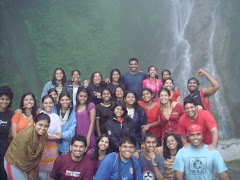
Often, some trips, some treks lodge themselves in memory and refuse to budge. What makes them so memorable is usually a very disastrous incident. Injured trekkers, water shortages or even adventures of roughing it out in the outdoors in the mornings (ahem!) are part of the deal. But the trek to Rajmachi last weekend, on the 1st and 2nd of May, had none of these. It was, well, ordinary. Almost forgettably so. But even then, I remember it well enough to write this piece. I remember it well because in some way, all of us were high on Rajmachi.
So there we were after weeks of co-ordinating. Twelve of us met at the Lonavala station, all geared up to the long walk up to the fort. The demographics of the group were slightly unusual. Being an unofficial trek, the number of ex-students (Anish, Rohan, Rucha, Gayatri and Jovy) was almost the same as the number of current students (Anujeet, Vallari, Mili, Ryan, Supraket and me). We even had a non-NC member, Kedar, with us.
In his usual Commander-in-chief style, Anish rounded us up and began the march towards the fort at about 6p.m. But all this was not before we ensured that all of us had at least 3 litres of water and enough food to last the night.
Now, loaded with enough water to flood the fort and bags full of Cup Noodles, we started walking. The first stop of our destination was to be the Tungarli Dam, which was the beginning of the actual trek. To reach here we passed the quiet bylanes of Lonavala. Here, I take a moment to mention that Lonavala was a beautiful place. I use the past tense here, because Mumbai seems to have slowly clawed itself into this quiet hilly resort in the form of empty Pepsi bottles and gutka packets which litter the floor. Also, if I have seen a place with an even bigger stray dog problem than Mumbai, it is here. Nevertheless, we walked on till a point where human encroachment (illegal or otherwise) reached a minimum. The only reminders of the scary metropolis in the making below were huge gravel-laden trucks and monstrous bulldozers. According to Mili, our very own Lonavala girl, they were making a road on the hill, which once comfortable motorable, would enable the government to sell the surrounding area. Hmm…
Our trek upwards, was oddly, not upwards at all! We were sort of walking, endlessly, on a long undulating path. It was narrow and covered with dust and gravel bits thrown off from the bulldozers. We went up and down and up again. We walked at a comfortable pace too, lest Mili (with excess baggage in her backpack) and I (with excess baggage on me!) were lagging behind! But in spite of our comfortable pace we managed to cover enough distance while daylight was still on our side. Then, the best part of the trek began.
Walking in the dark has a different charm about it. Firstly, it’s never completely dark. Once your eyes adjust, there’s this ghostly glow on everything. It’s not extremely beautiful. It’s more surreal, if anything. We could probably have walked on for what seemed like ages. The terrain rarely changed. It was the same undulating road, with either barren land or interruptions of dry vegetation juxtaposed against the now blue, black surrounding earth on both sides. That’s when a sort of a high sets in. it’s what makes feet fall in front of each other even when they’re tired. It’s this high we all were searching for. It’s exactly what makes 12 people come to the middle of nowhere and exert themselves after a tiring work week. Some call it Biophilia. In some cases its spread by the infectious bite of the WCNC Bug. Highly contagious…
At one point we halted at a small rocky junction. A quick break for tired feet. We even came across a lone trekker. There is probably something even more romantic about walking along these trails alone. We would never know. Our group by now had connected well. Almost all of us knew each other from earlier camps and treks. This was a good time to catch up.
There were parts of the trek when it got too dark. It was where there were sufficiently dense deciduous forests looming over the path to hide away the moonlight. Powerful torches came to aid and we successfully made it through these patches without tripping over rocks or treading over any snakes or other ground-dwelling wildlife in the dark (or so we believe).
After what seemed like a long time, we reached the village at the base of the fort. It’s a hamlet really, with a school and half a dozen houses and shops. A local elderly man advised us to set up camp right there. The fort at night isn’t safe, the villagers say. But coming up till here and not going up would have been pointless. So, on we marched.
In the short hike up to the temple below the fort, Commander-in-chief, along with Comrades Mili, Supraket, Rohan, Jovy and Ryan collected dry sticks, leaves and firewood. While some got busy trying to light a fire to boil water, Kedar was shooting off into bouts of paranoia and was mistaking the local emaciated dogs to be leopards!
But soon, all fear of any non-existent wild animals disappeared and stomachs started growling. After burning all those calories in the hike up, we promptly compensated by hogging on large quantities of cup noodles, parathas, eggs, bread, cheese and popcorn. Ryan, being creative as he is, even mixed a few of these together to come up with a culinary masterpiece!
Nothing could have made the night better, but something did. The one thing that tells you that you’re not in the city- a clear starry sky. It was something amazing. The moon had almost set by then and the stars became clearer. I tried for a moment to locate constellations but gave up. It’s at these times, when you’re looking at huge, burning balls of fire thousands and millions of light-years away that you begin to feel infinitesimally small. It’s a wonderful feeling.
Soon, tired and well fed, we dived headlong into deep slumber. The ones who did stay awake longer than the rest had to listen to the sounds of the forest form a melody with the resonating snores of the rest of us. But we only snore when we’re tired, don’t we?
The next morning, we decided to go right up to the top of the fort. After a climb that took not more than 20 minutes, we were overlooking the whole path we had trekked the previous day. It was a view from the top that words like breathtaking or splendid would only belittle. We’d all been to possibly more beautiful faraway places on previous camps. But when you know you’ve walked 13 kms oneway for this, it just make the place that much more special. Finally, we were, literally, high on Rajmachi.
We spent a few silent and some not-so-silent moments there. It was more relaxing than the whole night’s sleep hadn’t been. It really was something else. We even discovered a little bat-inhabited cave on the way.
The way down was quick and almost effortless. We reached the base village where we had a superbly delicious and ridiculously inexpensive breakfast of Poha and Nimbu Pani, prepared by a local household.
By this time it was almost 9 a.m. in the morning. Walking back in the increasingly ferocious sun would have been nothing short of suicide. So we took a jeep back to the station. It was a bumpy ride. But since we were 12 of us plus a driver squeezed into a sumo, we were well cushioned against the impact of the road.
In less than an hour or so we reached the Lonavala. The long trek up, the stay at the temple, the awesome starry sky, the climb to the fort in the morning, everything in less than 24 hours. We were definitely high on Rajmachi.
Wednesday, 6 May 2009

Tuesday, 5 May 2009
Thursday, 30 April 2009
Nature Camp 2009 Details
NatureCamp 2009 details
Posted in public interest for the NorthEast Camp (CourtesY-CROC)
Bare Necessities
Hey all,
We will need to carry certain stuff. Please take note of the following requirements and Do's n Don'ts:
1) Wear good shoes that are comfortable for your feet and have good GRIPS.
2) Carry lots of drinking water and food. Small one-litre bottles are not enough. Also packets of biscuits get monotonous. Get me some variety in food guys!
3) Remember that deodorants, perfumes, etc. attract insects.
4) Black, white, flower prints and bright coloured clothes, attract insects too. Dull Earth shades (greens, khaki, browns, greys) are your best option.
5) Jeans get heavy and soggy after they get wet. Try and avoid wearing jeans.
6) Carry your cell phones, wallets and other important and expensive articles in waterproof coverings.
7) A dry towel and a change of clothes may come in handy on longer treks.
8) Torches with extra bulbs and batteries are recommended for night treks.
9) A sleeping bag or a bed sheet comes in handy on overnight treks for sleeping and any other smart uses that you may come up with.
10) Rain coats, umbrellas, wind cheaters, warm clothes may be carried as per individual requirements.
11) Carry toiletries and medicines as per your requirements.
12) Carry a cap; it helps even while it's raining.
13) Remember to carry all your garbage back with you in your pockets or bags, to be disposed off in a Dustbin.
Happy Trekking. Cheers!! Croc.
- Stomach infections.
- Pain
-Motion sickness (Avomine)
-Urinary Tract infections
An antimalarial dose is required before travelling to the north east. Consult your doctor.
Leech therapy includes rock salt or tobacco. do carry them with you.
Rain gear is absolutely essential as the monsoons will hit the north east in may.
Good footwear is needed.
Hats and caps are required.
Do carry a notebook and a pen as well as crayons, colour pencils, etc.
Brush up on the north east as well as the places we are visiting.
In the case of emergencies, we have two contacts in the northeast. You may give your parents/relatives their numbers. Please send a request to natureclub.nc@gmail.com to get the contacts of these people.
thats one long list. If there are any problems , do contact me.
Bare Necessities
Hey all,
We will need to carry certain stuff. Please take note of the following requirements and Do's n Don'ts:
1) Wear good shoes that are comfortable for your feet and have good GRIPS.
2) Carry lots of drinking water and food. Small one-litre bottles are not enough. Also packets of biscuits get monotonous. Get me some variety in food guys!
3) Remember that deodorants, perfumes, etc. attract insects.
4) Black, white, flower prints and bright coloured clothes, attract insects too. Dull Earth shades (greens, khaki, browns, greys) are your best option.
5) Jeans get heavy and soggy after they get wet. Try and avoid wearing jeans.
6) Carry your cell phones, wallets and other important and expensive articles in waterproof coverings.
7) A dry towel and a change of clothes may come in handy on longer treks.
8) Torches with extra bulbs and batteries are recommended for night treks.
9) A sleeping bag or a bed sheet comes in handy on overnight treks for sleeping and any other smart uses that you may come up with.
10) Rain coats, umbrellas, wind cheaters, warm clothes may be carried as per individual requirements.
11) Carry toiletries and medicines as per your requirements.
12) Carry a cap; it helps even while it's raining.
13) Remember to carry all your garbage back with you in your pockets or bags, to be disposed off in a Dustbin.
Happy Trekking. Cheers!! Croc.
Camp details
Firstly the Camp cost has been increased by Rs. 600 as the cost of the inner line permits issued by the Mizoram Govt. has been revised.
Everyone coming for the camp is absolutely required to submit two passport sized photos and their addresses along with the local police station address to the nature club for the permits.
A Medical Certificate is also required from your doctor certifying that you are physically fit to trek and also mentioning if any of the mentioned medical disorders and conditions are prevailing.
These include
-- Tuberculosis
--Juvenile diabetes
--Anaphylaxis or Allergies
--Asthma,etc
If you do suffer from any of the above appropriate medications and recommendations from the doctor should be followed
College students are required to submit the consent forms within the next two days.
College students are required to carry their college identity cards along with a supplementary Id card (Driving license, any other i card)
Medication to be carried as per your doctors recommendations. Medications for the follwing are neededEveryone coming for the camp is absolutely required to submit two passport sized photos and their addresses along with the local police station address to the nature club for the permits.
A Medical Certificate is also required from your doctor certifying that you are physically fit to trek and also mentioning if any of the mentioned medical disorders and conditions are prevailing.
These include
-- Tuberculosis
--Juvenile diabetes
--Anaphylaxis or Allergies
--Asthma,etc
If you do suffer from any of the above appropriate medications and recommendations from the doctor should be followed
College students are required to submit the consent forms within the next two days.
College students are required to carry their college identity cards along with a supplementary Id card (Driving license, any other i card)
ITINERARY
9th May Depart from Lokmanya Tilak Terminus. Kurla by the 5645 Mumbai Guwahati express at 7.40 am.Reporting time is 6.30 am for everyone. Baggage checks may be conducted at the station by the railway police so be prepared for it.
Dress conservatively during the train ride and be prepared for very hot conditions as we would be passing through arid terrain and temperatures in excess of 40C
10th May - Passing through Madhya Pradesh, Uttar Pradesh and Bihar.
11th May- Arrival at Guwahati Station at 11.30 am (But be prepared for delays)
From station, board the buses (we have two of them) and head off to Kalak Shetra. The Srimanta Sankardeva kalakshetra has been set up as a grand exposition of the life and culture of the people of Assam. Named after the greatest Vaishnava saint and the greatest integrator of the Assamese society Srimanta Sankardeva, the Kalakshetra is a multi-Arts complex.It houses a Central Museum where cultural objects and day-to-day articles used by different ethnic groups will be preserved and exhibited, an Open Air Theatre with 2000 capacity to hold folk festivals and to present traditional dance and drama of the State, an Artists' Village which offers the visitors and the residents an atmosphere of the village of Assam, the Sahitya Bhavan which is a library of rare books and manuscripts, the Lalit-Kala Bhavan which has sufficient space for exhibition, art and sculpture workshops, and a Heritage Park. The Kalakshetra has been chosen as the venue for many cultural activities.
Explore the places of in Guwahati. Night halt at Guwahati in Kalakshetra
12th May - Leave for Shillong, Meghalaya early morning. Reach Shillong in about 1.5 hours. Check into hotel at Shillong and drop baggage into rooms and head off to Cherapunji. Explore the numerous stalagmite and stalactite formations as well as the caves and underground water pathways. Cherapunjee means “the abode of clouds”.
12th May - Evening explore Shillong. Night halt at Shillong
13th May - Explore Shillong and the Garo, Khasi and the Jaintia hills. Nigh halt at Shillong.
14th May - Early morning - Leave for Aizawl, Mizoram. It is a 12 hour journey. Reach Aizawl by evening. Explore places of interest. Night halt at Aizawl.
15th May - Aizawl and surrounding places.
16th May - Leave Aizawl early morning for Blue Mountain National Park also known as the Phawngpui National Park, Mizoram.
The Phawngpui National Park is situated in South Eastern Mizoram adjacent to Myanmar border. The highest peak in Mizoram, the Phawngpui (2360m) is located within this Park. The total area of the Park is 50 Sq. Km. The important wild animals and birds found in this Park are Ghoral, Serrow, Barking deer, Sambar, Leopard, Blyth's tragopan, Kaleej Pheasant, Hoolock Gibbon, Common Langur, Rhesus macaque, Stump tail macaque and variety of birds and orchids.
17th May - Phawngpui National Park
18th May - Phawngpui National Park. Leave Blue mountain for Aizawl in the afternoon. Night halt at Aizawl.
19th May - Leave for Shillong early morning. Night Halt at Shillong.
20th May - Leave for Guwahati in the morning. Lunch in Guwahati. Depart from Mumbai at 16.45 for Mumbai.
21st May on the train
22nd May - Arrival in Mumbai at 20.00 hrs at LTT, Kurla
Dress conservatively during the train ride and be prepared for very hot conditions as we would be passing through arid terrain and temperatures in excess of 40C
10th May - Passing through Madhya Pradesh, Uttar Pradesh and Bihar.
11th May- Arrival at Guwahati Station at 11.30 am (But be prepared for delays)
From station, board the buses (we have two of them) and head off to Kalak Shetra. The Srimanta Sankardeva kalakshetra has been set up as a grand exposition of the life and culture of the people of Assam. Named after the greatest Vaishnava saint and the greatest integrator of the Assamese society Srimanta Sankardeva, the Kalakshetra is a multi-Arts complex.It houses a Central Museum where cultural objects and day-to-day articles used by different ethnic groups will be preserved and exhibited, an Open Air Theatre with 2000 capacity to hold folk festivals and to present traditional dance and drama of the State, an Artists' Village which offers the visitors and the residents an atmosphere of the village of Assam, the Sahitya Bhavan which is a library of rare books and manuscripts, the Lalit-Kala Bhavan which has sufficient space for exhibition, art and sculpture workshops, and a Heritage Park. The Kalakshetra has been chosen as the venue for many cultural activities.
Explore the places of in Guwahati. Night halt at Guwahati in Kalakshetra
12th May - Leave for Shillong, Meghalaya early morning. Reach Shillong in about 1.5 hours. Check into hotel at Shillong and drop baggage into rooms and head off to Cherapunji. Explore the numerous stalagmite and stalactite formations as well as the caves and underground water pathways. Cherapunjee means “the abode of clouds”.
12th May - Evening explore Shillong. Night halt at Shillong
13th May - Explore Shillong and the Garo, Khasi and the Jaintia hills. Nigh halt at Shillong.
14th May - Early morning - Leave for Aizawl, Mizoram. It is a 12 hour journey. Reach Aizawl by evening. Explore places of interest. Night halt at Aizawl.
15th May - Aizawl and surrounding places.
16th May - Leave Aizawl early morning for Blue Mountain National Park also known as the Phawngpui National Park, Mizoram.
The Phawngpui National Park is situated in South Eastern Mizoram adjacent to Myanmar border. The highest peak in Mizoram, the Phawngpui (2360m) is located within this Park. The total area of the Park is 50 Sq. Km. The important wild animals and birds found in this Park are Ghoral, Serrow, Barking deer, Sambar, Leopard, Blyth's tragopan, Kaleej Pheasant, Hoolock Gibbon, Common Langur, Rhesus macaque, Stump tail macaque and variety of birds and orchids.
17th May - Phawngpui National Park
18th May - Phawngpui National Park. Leave Blue mountain for Aizawl in the afternoon. Night halt at Aizawl.
19th May - Leave for Shillong early morning. Night Halt at Shillong.
20th May - Leave for Guwahati in the morning. Lunch in Guwahati. Depart from Mumbai at 16.45 for Mumbai.
21st May on the train
22nd May - Arrival in Mumbai at 20.00 hrs at LTT, Kurla
- Stomach infections.
- Pain
-Motion sickness (Avomine)
-Urinary Tract infections
An antimalarial dose is required before travelling to the north east. Consult your doctor.
Leech therapy includes rock salt or tobacco. do carry them with you.
Rain gear is absolutely essential as the monsoons will hit the north east in may.
Good footwear is needed.
Hats and caps are required.
Do carry a notebook and a pen as well as crayons, colour pencils, etc.
Brush up on the north east as well as the places we are visiting.
In the case of emergencies, we have two contacts in the northeast. You may give your parents/relatives their numbers. Please send a request to natureclub.nc@gmail.com to get the contacts of these people.
thats one long list. If there are any problems , do contact me.
Saturday, 3 January 2009
WCNC NatureCamp 09
The WCNC Nature Camp this year will be covering the North East region of India extensively. We plan to visit Meghalaya, Mizoram, Tripura and Assam.
Meghalaya
"Abode of the Clouds”, this is Meghalaya, the destination which soothes the minds of weary travellers. Clouds are always found during the monsoon season nestling in the tropical forest valleys of Garo Hills or in the temperate pine forests of the Khasi and Jaintia hills.Situated in the North Eastern corner of India, Meghalaya is bounded by Assam in the north and east, and the plains of Bangladesh in the south and west. The state covers an area of 22,429 sq. kms with a population density of 78.5 per sq. km.TKhasihe name describes the climatic phenomenon that brings torrential rain to its hills and forests, these same hills and mountains are responsible for this climatic experience as they force rain clouds coming in from the Bay of Bengal to move up - resulting in heavy rain. The Cherrapunjee belt receives the highest rainfall in the world.The higher ranges of the Khasi/Jaintia hills enjoy a cool, bracing, temperate climate while the winters can be cold. The Garo hills on the other hand, is at a lower altitude, and has tropical vegetation. The summer months in Tura, the administrative capital of Garo hills, are warm and humid whereas winters are pleasant with a slight chill.Meghalaya became the 21st State of the Indian Union, when it achieved full-fledged Statehood in 1972. Home to the Khasi, Garo, Jaintia and some lesser known tribes, Meghalaya boasts of a unique matrilineal lineage system practiced by all the three major tribes with some degree of variation. Property is inherited by the women, and the youngest daughter is the heiress of the ancestral property in the Khasi/Jaintia tradition. The Garos have a slight variation, if the youngest daughter is found not worthy, the property may be given to any of the other daughters.
Mizoram
Mizoram lies in the southernmost outpost of North Eastern India, the land of the Blue Mountains. Manipur, Assam and Tripura bind the northern end of this little island of tranquility with neighbouring countries Myanmar and Bangladesh nestling most of the state between them. Evergreen ranges of Mizoram hills with blooms of exotic flora and dense bamboo jungles rise sharply from the plains of Assam in a north south direction. These hills and plunging gorges are criss-crossed by gushing rivers and sparkling waterfalls. Highest among its several peaks is the Phawngpui The Blue Mountain.In sharp contrast to the dense jungles and steep hills is a rugged quilt of lush paddy fields all the way from the center of the state towards the Myanmar border.Oral tradition reveals (there is no known recorded history) that the Mizos migrated from their homeland in China about 3 centuries ago, in search of new pastures and settled in these remote Mizo Hills (Lushai Hills). In the nineteenth century this region was annexed to Assam, under the British rule, as the Lushai Hills District and in February 1972, it became the 23rd state of the Indian Union.
Tripura
Tripura is one of the seven states in the north eastern part of India located between 22 degree and 56 minutes and 24 degree and 32 minutes north latitude and between 90 degree and 09 minutes and 92 degree and 20 minutes east latitude. It is bounded on the north, west, south and south-east by Bangladesh whereas in the east it has a common boundary with Assam and Mizoram.There is a common belief that the name of the State has originated from "Tripura Sundari" - the presiding deity of the land which is famous as one of the 51 pethos of Hindu Pilgrims. Apart from this traditional view it is believed that originally the land was known as "Tuipra" meaning a land adjoining the water. It is fact that in days of yore the boundaries of Tripura was extended up to the Bay of Bengal when its rulers held sway from Garo hills to Arakan.The history of Tripura as a administrative unit dates back to the days of Maharajas when the territory was a native State. It is significant to note that all though Tripura was conquered by force of arms in 1761, no Political agents was appointed in the State till 1871 - a gap of 110 years.
Charges: Rs. 8000 for students of Wilson College
Rs.9000 for ex-students.
Dates: May 2nd - 19th,2009
Price includes:
1.Travel - Mumbai to Guwahati on 2nd May by Guwahati Express 5646 from LTT, Mumbai and back by the same train on 17th May from Guwahati, Assam.
2.Meals - Veg and Non Veg (Except during the train ride)
3.Accommodation.
4.Forest entry fees.
5.Bus travel within states.
Registration: January 3rd to February 1st,2009
Payment details :
STUDENTS
Rs. 2000(NON-REFUNDABLE) to confirm registration before February 1st +Rs.3000 before March 1st (2500 refund for cancellations before March20th)+ Rs. 3000 before April 2nd.
EX STUDENTS
Rs. 3000(NON-REFUNDABLE) to confirm registration before February 1st + Rs.3000 before March 1st (2500 refund for cancellations before March20th) + Rs. 3000 before April 2nd.
For more details on the places on the Itinerary visit www.wcnctrips.blogspot.com
For inquiries contact
WCNC - 9769 455 729
Glen D'souza - 9819 211 523
Eisha Mhatre - 9221 077 365
Disha Pinge - 9819 355 707
Meghalaya
"Abode of the Clouds”, this is Meghalaya, the destination which soothes the minds of weary travellers. Clouds are always found during the monsoon season nestling in the tropical forest valleys of Garo Hills or in the temperate pine forests of the Khasi and Jaintia hills.Situated in the North Eastern corner of India, Meghalaya is bounded by Assam in the north and east, and the plains of Bangladesh in the south and west. The state covers an area of 22,429 sq. kms with a population density of 78.5 per sq. km.TKhasihe name describes the climatic phenomenon that brings torrential rain to its hills and forests, these same hills and mountains are responsible for this climatic experience as they force rain clouds coming in from the Bay of Bengal to move up - resulting in heavy rain. The Cherrapunjee belt receives the highest rainfall in the world.The higher ranges of the Khasi/Jaintia hills enjoy a cool, bracing, temperate climate while the winters can be cold. The Garo hills on the other hand, is at a lower altitude, and has tropical vegetation. The summer months in Tura, the administrative capital of Garo hills, are warm and humid whereas winters are pleasant with a slight chill.Meghalaya became the 21st State of the Indian Union, when it achieved full-fledged Statehood in 1972. Home to the Khasi, Garo, Jaintia and some lesser known tribes, Meghalaya boasts of a unique matrilineal lineage system practiced by all the three major tribes with some degree of variation. Property is inherited by the women, and the youngest daughter is the heiress of the ancestral property in the Khasi/Jaintia tradition. The Garos have a slight variation, if the youngest daughter is found not worthy, the property may be given to any of the other daughters.
Mizoram
Mizoram lies in the southernmost outpost of North Eastern India, the land of the Blue Mountains. Manipur, Assam and Tripura bind the northern end of this little island of tranquility with neighbouring countries Myanmar and Bangladesh nestling most of the state between them. Evergreen ranges of Mizoram hills with blooms of exotic flora and dense bamboo jungles rise sharply from the plains of Assam in a north south direction. These hills and plunging gorges are criss-crossed by gushing rivers and sparkling waterfalls. Highest among its several peaks is the Phawngpui The Blue Mountain.In sharp contrast to the dense jungles and steep hills is a rugged quilt of lush paddy fields all the way from the center of the state towards the Myanmar border.Oral tradition reveals (there is no known recorded history) that the Mizos migrated from their homeland in China about 3 centuries ago, in search of new pastures and settled in these remote Mizo Hills (Lushai Hills). In the nineteenth century this region was annexed to Assam, under the British rule, as the Lushai Hills District and in February 1972, it became the 23rd state of the Indian Union.
Tripura
Tripura is one of the seven states in the north eastern part of India located between 22 degree and 56 minutes and 24 degree and 32 minutes north latitude and between 90 degree and 09 minutes and 92 degree and 20 minutes east latitude. It is bounded on the north, west, south and south-east by Bangladesh whereas in the east it has a common boundary with Assam and Mizoram.There is a common belief that the name of the State has originated from "Tripura Sundari" - the presiding deity of the land which is famous as one of the 51 pethos of Hindu Pilgrims. Apart from this traditional view it is believed that originally the land was known as "Tuipra" meaning a land adjoining the water. It is fact that in days of yore the boundaries of Tripura was extended up to the Bay of Bengal when its rulers held sway from Garo hills to Arakan.The history of Tripura as a administrative unit dates back to the days of Maharajas when the territory was a native State. It is significant to note that all though Tripura was conquered by force of arms in 1761, no Political agents was appointed in the State till 1871 - a gap of 110 years.
Charges: Rs. 8000 for students of Wilson College
Rs.9000 for ex-students.
Dates: May 2nd - 19th,2009
Price includes:
1.Travel - Mumbai to Guwahati on 2nd May by Guwahati Express 5646 from LTT, Mumbai and back by the same train on 17th May from Guwahati, Assam.
2.Meals - Veg and Non Veg (Except during the train ride)
3.Accommodation.
4.Forest entry fees.
5.Bus travel within states.
Registration: January 3rd to February 1st,2009
Payment details :
STUDENTS
Rs. 2000(NON-REFUNDABLE) to confirm registration before February 1st +Rs.3000 before March 1st (2500 refund for cancellations before March20th)+ Rs. 3000 before April 2nd.
EX STUDENTS
Rs. 3000(NON-REFUNDABLE) to confirm registration before February 1st + Rs.3000 before March 1st (2500 refund for cancellations before March20th) + Rs. 3000 before April 2nd.
For more details on the places on the Itinerary visit www.wcnctrips.blogspot.com
For inquiries contact
WCNC - 9769 455 729
Glen D'souza - 9819 211 523
Eisha Mhatre - 9221 077 365
Disha Pinge - 9819 355 707
Monday, 24 November 2008
Silent? Valley….
It’s one of those days when if you’d say Good Morning, you would really mean it. I mean not just the usual sun-was-shining-birds-were-chirping routine, but a really nice quiet walk in the forest. And what better name would they have found for this place other than Silent Valley.
After a long jeep ride through the forest and short meal of curd rice, I was all set for a good walk. We walked for a short while and reached the river Kunthi. Several members of the group even had a great time shaking the uncertain wooden-iron-rope bridge across the river and testing its strength, and theirs. Fun.
We sat there for a while looking over the river which we were forbidden to jump into. We were about 3 days into the camp (inclusive of train journey) and this was the first real water body in proximity. I am sure more than one of us had resisted the urge the jump out of clothing and plunge in to the water! So as this joy was sacrificed, the youngest of the troop plunged headlong into a photography session by the bridge, soon to be joined by the rest. It is believed that Silent Valley has ever since been echoing of clicks and flashes.
On the way back however, I began to wonder how much longer the name of this place would stay. We were told that one of the reasons for Silent valley being so silent was the absence of a certain insect called Cicada which happens to be very noisy and compensates for the rest of the insect world being largely mute.
We came to a point in the forest on the way back where it was resounding of Cicada. Not one or too but several of them. The sheer vibration the noise was creating in the air would put a Nokia 1100 to shame! Had Shakespeare been alive, he probably would have used this case instead of the rose to prove his what’s-in-a-name jig. But then again, the forest was good, so you don’t really care about the cicada.
We even sat down at a nice little leech-free zone to pen things down before continuing the walk. Not so bad for a good morning in a not-so-Silent Valley.
After a long jeep ride through the forest and short meal of curd rice, I was all set for a good walk. We walked for a short while and reached the river Kunthi. Several members of the group even had a great time shaking the uncertain wooden-iron-rope bridge across the river and testing its strength, and theirs. Fun.

We sat there for a while looking over the river which we were forbidden to jump into. We were about 3 days into the camp (inclusive of train journey) and this was the first real water body in proximity. I am sure more than one of us had resisted the urge the jump out of clothing and plunge in to the water! So as this joy was sacrificed, the youngest of the troop plunged headlong into a photography session by the bridge, soon to be joined by the rest. It is believed that Silent Valley has ever since been echoing of clicks and flashes.
On the way back however, I began to wonder how much longer the name of this place would stay. We were told that one of the reasons for Silent valley being so silent was the absence of a certain insect called Cicada which happens to be very noisy and compensates for the rest of the insect world being largely mute.
We came to a point in the forest on the way back where it was resounding of Cicada. Not one or too but several of them. The sheer vibration the noise was creating in the air would put a Nokia 1100 to shame! Had Shakespeare been alive, he probably would have used this case instead of the rose to prove his what’s-in-a-name jig. But then again, the forest was good, so you don’t really care about the cicada.
We even sat down at a nice little leech-free zone to pen things down before continuing the walk. Not so bad for a good morning in a not-so-Silent Valley.
Sunday, 23 November 2008
Tyger Tyger, Burnt away!
It’s almost been a very long time now since the last tiger roamed in the wild. The jungles don’t exist anymore. The balance was upset. The apex predator, a natural indicator gone, herbivore population explosion, deforestation, climate change, global warming,….., the list goes on. There are very few of us left today. We thought we’d make it, but the technology we created wasn’t enough to insulate us. In fact, that is exactly what did us in. While sustainable development is still just a bookish idea, we’re endangered, and edging dangerously close to extinction. Yes, we the humans. The web is upset, and nature is getting back at us. Natural disasters, epidemics and an environment on earth that is hostile to life forms. There are fewer of us than was ever imagined before, and we too are dying out. This is it. They say your entire life flashes before your eyes just before you die…
2008: A few weeks ago, it was discovered that the tiger population was just over a thousand individuals. And that too, is an official estimate. Don’t we all know what a notorious reputation “official estimates” have! So while state governments are in denial mode and most of us anyway don’t care, the stripes are gone for good. Even if they do accept the figures and make genuine attempts to “Save the tiger”, how possible is it? The gene pool has already been reduced. Even if we can make the species go on for a few more decades, it won’t be long before genetic mutation gets the better of the tiger. In breeding will lead to cubs being born with defects that will make survival in the wild even more difficult. They too will be gone some day. All the tigers. Just pictures left behind, to teach the kids. In those pictures, somewhere among the stripes, she’ll look at us again. A blank stare.
The 21st century: I remember standing in the Shahu Palace of Kolhapur. It’s a museum today. There were glass cases full of stuffed animals. One particular case had several tigers. There were cubs, males, females, almost every size. I remember being told that killing a tiger was considered a sign of valour for the royalty.
Picture this:
A hunting party vs. a solitary animal
Men armed with guns vs. a tiger armed with nothing but its own ill-adapted body
Men on elephants vs. a tiger on foot, soft velvet paws
A planned murder vs. a struggle for survival
… and valour they called it. I remember those eyes looking through the glass. Those dead eyes. A blank stare.
The 20th Century: independence, many were to discover, didn’t come cheap. I live in a village in India. I don’t know what freedom means to me. It hasn’t brought me anything. The forests were my land. It was taken away from me. I know I need to feed myself, my family. When people are willing to pay money for poaching, for buying fur, bones and almost every part of the tiger’s body, I don’t hesitate before I shoot that animal stuck in my snare trap. But I remember that face, which haunts me sometimes. As if it were saying something to me. A secret message. A blank stare.
Late 19th century: “Buffalo calves were tied in the jungle as bait. About fifty elephants were sent out to circle the place where the tiger was likely to conceal itself. Then, when the ring was ready, orders were given for a couple of elephants to go inside and find out where the tiger was hidden. The tiger which remained encircled for such a long time usually got enraged, charging at the elephant that went near it. In the beginning it’s exciting, but after a while, the tiger becomes exhausted and lies down… With two or three rings being made a day, I have seen hundreds of tigers being shot.”
-Maharaja Bahadur Banali’s Acount in a Manual on Tiger Hunting.
I came across this account while I was watching a documentary on the British Empire. This documentary also went on to say that in just ten weeks, Viceroy Lord Linlithgow’s hunt killed 38 rhino, 27 leopards, 15 bears and 120 tigers. The visuals were shocking. Men standing over the corpses of scores of tigers. Congratulating each other for having brought home another rug. A rug with a blank stare.
There are centuries of memories. I have seen the tiger. I killed it. I will pay for it. I am the last Homo sapien left on earth. Possibly the last in the universe. I look up at the blank, cloudless skies. Just as blank, as the blank stare.
2008: A few weeks ago, it was discovered that the tiger population was just over a thousand individuals. And that too, is an official estimate. Don’t we all know what a notorious reputation “official estimates” have! So while state governments are in denial mode and most of us anyway don’t care, the stripes are gone for good. Even if they do accept the figures and make genuine attempts to “Save the tiger”, how possible is it? The gene pool has already been reduced. Even if we can make the species go on for a few more decades, it won’t be long before genetic mutation gets the better of the tiger. In breeding will lead to cubs being born with defects that will make survival in the wild even more difficult. They too will be gone some day. All the tigers. Just pictures left behind, to teach the kids. In those pictures, somewhere among the stripes, she’ll look at us again. A blank stare.
The 21st century: I remember standing in the Shahu Palace of Kolhapur. It’s a museum today. There were glass cases full of stuffed animals. One particular case had several tigers. There were cubs, males, females, almost every size. I remember being told that killing a tiger was considered a sign of valour for the royalty.
Picture this:
A hunting party vs. a solitary animal
Men armed with guns vs. a tiger armed with nothing but its own ill-adapted body
Men on elephants vs. a tiger on foot, soft velvet paws
A planned murder vs. a struggle for survival
… and valour they called it. I remember those eyes looking through the glass. Those dead eyes. A blank stare.
The 20th Century: independence, many were to discover, didn’t come cheap. I live in a village in India. I don’t know what freedom means to me. It hasn’t brought me anything. The forests were my land. It was taken away from me. I know I need to feed myself, my family. When people are willing to pay money for poaching, for buying fur, bones and almost every part of the tiger’s body, I don’t hesitate before I shoot that animal stuck in my snare trap. But I remember that face, which haunts me sometimes. As if it were saying something to me. A secret message. A blank stare.
Late 19th century: “Buffalo calves were tied in the jungle as bait. About fifty elephants were sent out to circle the place where the tiger was likely to conceal itself. Then, when the ring was ready, orders were given for a couple of elephants to go inside and find out where the tiger was hidden. The tiger which remained encircled for such a long time usually got enraged, charging at the elephant that went near it. In the beginning it’s exciting, but after a while, the tiger becomes exhausted and lies down… With two or three rings being made a day, I have seen hundreds of tigers being shot.”
-Maharaja Bahadur Banali’s Acount in a Manual on Tiger Hunting.
I came across this account while I was watching a documentary on the British Empire. This documentary also went on to say that in just ten weeks, Viceroy Lord Linlithgow’s hunt killed 38 rhino, 27 leopards, 15 bears and 120 tigers. The visuals were shocking. Men standing over the corpses of scores of tigers. Congratulating each other for having brought home another rug. A rug with a blank stare.
There are centuries of memories. I have seen the tiger. I killed it. I will pay for it. I am the last Homo sapien left on earth. Possibly the last in the universe. I look up at the blank, cloudless skies. Just as blank, as the blank stare.
Tuesday, 23 September 2008
Wanderlust
*Came across this poem in a book I'm reading and I thought a lot of the Nature Clubbers could relate*
Wander, wander,
wandering
meandering,
the urge to roam,
to dance,
to fly,
to be,
the search for
free,
the need to see
to go
to find
to search
to do,
my thirsts
so easily quenched
so close to home
and yours so grand,
so elegant,
so marvelous,
climbing mountaintops
and elephants
and tiger hunts
and dancing bears
and far off stars
and trips to mars
and all of it
so wild,
so vast,
so free,
as you go wander,
wander,
wandering,
and then the best
part of all
when, satisfied,
complete,
and happy now,
you wander
slowly
home
to me.
Wander, wander,
wandering
meandering,
the urge to roam,
to dance,
to fly,
to be,
the search for
free,
the need to see
to go
to find
to search
to do,
my thirsts
so easily quenched
so close to home
and yours so grand,
so elegant,
so marvelous,
climbing mountaintops
and elephants
and tiger hunts
and dancing bears
and far off stars
and trips to mars
and all of it
so wild,
so vast,
so free,
as you go wander,
wander,
wandering,
and then the best
part of all
when, satisfied,
complete,
and happy now,
you wander
slowly
home
to me.
Sunday, 21 September 2008
Happy Birthday To Us!
29 years is a lot longer than most of us have walked the planet and it is has been one amazing ride. I haven’t been around for long but I have heard enough stories and plenty of ‘gyaan’ from the seniors to build my picture of how the past years have been.
At this point I have to make a disclaimer. Most people less than a couple of camps old will not be able to understand much of this article. But since this is the reunion special, I take the liberty of letting myself go on pen and paper (sorry, keyboard and monitor) here.
I have heard of all the beautiful places it has been to, and all the jungles it has explored. All the not-so-easy-on-the-backside- bus rides and all the towns wiped out of food! Cameras in the stream and eunuchs in the train! I have, in a way, been a part of it all.
What truly is the most amazing part of the experience is that every camp, every event has its story to tell. Something has always happened. The sleepless nights of the exhibitions and all the ambitious plans, some successful, others not so much!
For those of us who have been an active part of the Nature Club can probably never explain to anyone else what it is like. To be lost in forests somewhere, with no network, or to be stuck at sub-zero temperatures at one of the highest places in the country. To be stuck in a train for 60 hours or to just plunge into a random waterfall by the road!
Someone once saw the insect-bites I brought home from a camp and asked, “Why? Why do you guys do this to yourselves?”
I had no answer. Or at least no words to put it in. You have to experience it to know what it’s like. What it’s like to be a part of NC, and a part of this community. This remote sense of adventure and going to places where you would dare not set foot otherwise!
NC has also had some of the wittiest (and the most frustrating) jokes I have ever heard. Somehow, even in the darkest of situations, even when you know you’re in some serious trouble, there will always be someone who’ll come up with the odd wisecracks. And not just then, there are other times too. We are in a forest somewhere, and the COM (NC terminology) is talking about a rare tree or some bird call (which, by the way, I always pretend to hear, like most others) and someone would find something funny.
I have also met some amazing people here. The seniors who never carry food on treks and the juniors who are always noisy. The crazy nicknames everyone has and everyone’s individual, most specific quirks and that one poor guy (or girl) who becomes joke of the season.
Tradition too has been a part of NC. Each chairperson competes with the predecessor to beat the number of memberships! The dumb charades and the antaksharis with the same songs sung over and over again on every bus ride. The whacks, the exhibitions and the just-cant-take-one-more-step treks! It’s like rites of passage. Everyone goes through it and we are one proud lot! So let’s conclude this little trip down memory lane with…
“Sir! I just saw a spotted dove!”
“How do you know it was a spotted dove?”
“I just spotted it!”
WHACK!
At this point I have to make a disclaimer. Most people less than a couple of camps old will not be able to understand much of this article. But since this is the reunion special, I take the liberty of letting myself go on pen and paper (sorry, keyboard and monitor) here.
I have heard of all the beautiful places it has been to, and all the jungles it has explored. All the not-so-easy-on-the-backside- bus rides and all the towns wiped out of food! Cameras in the stream and eunuchs in the train! I have, in a way, been a part of it all.
What truly is the most amazing part of the experience is that every camp, every event has its story to tell. Something has always happened. The sleepless nights of the exhibitions and all the ambitious plans, some successful, others not so much!
For those of us who have been an active part of the Nature Club can probably never explain to anyone else what it is like. To be lost in forests somewhere, with no network, or to be stuck at sub-zero temperatures at one of the highest places in the country. To be stuck in a train for 60 hours or to just plunge into a random waterfall by the road!
Someone once saw the insect-bites I brought home from a camp and asked, “Why? Why do you guys do this to yourselves?”
I had no answer. Or at least no words to put it in. You have to experience it to know what it’s like. What it’s like to be a part of NC, and a part of this community. This remote sense of adventure and going to places where you would dare not set foot otherwise!
NC has also had some of the wittiest (and the most frustrating) jokes I have ever heard. Somehow, even in the darkest of situations, even when you know you’re in some serious trouble, there will always be someone who’ll come up with the odd wisecracks. And not just then, there are other times too. We are in a forest somewhere, and the COM (NC terminology) is talking about a rare tree or some bird call (which, by the way, I always pretend to hear, like most others) and someone would find something funny.
I have also met some amazing people here. The seniors who never carry food on treks and the juniors who are always noisy. The crazy nicknames everyone has and everyone’s individual, most specific quirks and that one poor guy (or girl) who becomes joke of the season.
Tradition too has been a part of NC. Each chairperson competes with the predecessor to beat the number of memberships! The dumb charades and the antaksharis with the same songs sung over and over again on every bus ride. The whacks, the exhibitions and the just-cant-take-one-more-step treks! It’s like rites of passage. Everyone goes through it and we are one proud lot! So let’s conclude this little trip down memory lane with…
“Sir! I just saw a spotted dove!”
“How do you know it was a spotted dove?”
“I just spotted it!”
WHACK!
Monday, 25 August 2008
Looking for 'Someday'
Kohima is a quiet town. Quiet on the outside, but look closely, and everyone is screaming within, silently. The manifestations of anger here are many and suppressed. It shows itself in a villager’s  dao or maybe in that soldier’s uniform or in as a little child playing in the alley and in those quiet eyes that stare at us from the dingy houses in the bylanes. The anger is all around us in a cry for independence and a daily struggle for survival.In the middle of this chaos stands the Kohima War Cemetery. It is a gruesome reminder of the battle in Kohima between the Allied forces and the Japanese during the Second World War. The graves of the soldiers of the Allied forces lie in rows next to each other with a simple stone plate to tell the tale of the boy who lies six feet under.I use the word ‘boy’ for a reason. The soldiers were no older than twenty-five. Most were much younger. Lives cut short by a pointless war in which all nations were destroyed in victory or defeat. As I walked past the epitaphs, one in particular caught my attention. As I read it, it felt like something within me was sinking and falling away, leaving behind a void. A void with a question. A 22-year-old soldier’s parents had inscribed on his headstone:
 dao or maybe in that soldier’s uniform or in as a little child playing in the alley and in those quiet eyes that stare at us from the dingy houses in the bylanes. The anger is all around us in a cry for independence and a daily struggle for survival.In the middle of this chaos stands the Kohima War Cemetery. It is a gruesome reminder of the battle in Kohima between the Allied forces and the Japanese during the Second World War. The graves of the soldiers of the Allied forces lie in rows next to each other with a simple stone plate to tell the tale of the boy who lies six feet under.I use the word ‘boy’ for a reason. The soldiers were no older than twenty-five. Most were much younger. Lives cut short by a pointless war in which all nations were destroyed in victory or defeat. As I walked past the epitaphs, one in particular caught my attention. As I read it, it felt like something within me was sinking and falling away, leaving behind a void. A void with a question. A 22-year-old soldier’s parents had inscribed on his headstone:
 “Our Beloved Son, gave his life so that we may live,Someday we will understand.”
The question wasn’t whether that ‘someday’ ever came. The question is that even today in Kohima and so many other parts of the world, parents are still looking for ‘someday’. At that moment nothing matters- patriotism, politics, war, peace, independence, courage, victory, defeat…hollow words. All that mattered was that a boy had lost his life. I began to wonder what his last moment could have been like. That one last painful, painless moment. The pride of having fallen at war? Or the regret of a life unfinished? Could anyone ever know?My eyes welled-up for a stranger who lay there below the  ground. Why? Because his reality was no different than mine. A cruel irony, as I stood by a soldier’s grave, a convoy of military trucks passed by on the road below. There were boys there too. A fragile boundary between the soldiers above the ground and those below it, even sixty-three years later. Sixty-three years after a boy’s parents wished to come to terms with his death, we are still struggling to come to terms with our lives.
 ground. Why? Because his reality was no different than mine. A cruel irony, as I stood by a soldier’s grave, a convoy of military trucks passed by on the road below. There were boys there too. A fragile boundary between the soldiers above the ground and those below it, even sixty-three years later. Sixty-three years after a boy’s parents wished to come to terms with his death, we are still struggling to come to terms with our lives.
Someday we will understand
Friday, 22 August 2008
Shhh...
An account of my experience on evening on the banks of river Kameng in Bhalukpong, Arunachal Pradesh, this summer. This is the closest I could have come to describing it in words...I am sitting by the river staring at the water. Its flowing away to someone else. The white rocks on the river bed shine like giant dew drops perfectly round. And there is silence…It is a silence I haven’t known in a long time. No people talking, no TV blasting, no vehicles honking. Just a silent gushing of the river. A faraway bird calls from the trees on the other side. For a moment I try to place it in an encyclopaedia, in a bird book, in my mind. Almost immediately I give up, chasing away every thought. A strange thought-free floating state. And there is silence…There are people around me, who like me are hearing the silence. I lie down to move them out of my sight and to stare at the sky, free from human beings. A blue canvas spread across my eyes, till a cloud floats in to interrupt the monochrome. And there is silence…As I lie there, for a moment, I experience the rawness of being alive. For a moment, I have a sudden realization that I am but a part of the landscape, a part of the web, and my senses absorb it all. My clothes, shoes, watch, backpack….all seem alien, like they are distancing me from nature. And then, in my mind, for one moment, the boundaries begin to blur and I feel a sort of sinking, like I am melting into the rocks, becoming a part of them. For one moment I am no longer human, just alive, as alive as could be. And the moment is gone, And there is silence…
Friday, 13 July 2007
A New Beginning.
It was a cold morning in Diskit with colder water to brush our already numb teeth. Despite the fact that we had to reach North Pullu only after 1100 hrs. the Crazy Old Man woke us up in the middle of the night. The evening before, we had learned the hard way that water heated for half an hour would reach to a temperature that would be referred to in Mumbai as saadaa paani. So without fussing over the numbing experienced by us at both the extreme ends of the alimentary canal, we got ready.
We assembled at the hotel dinning room with empty water bottles and equally empty stomachs. A brand new day and a brand new beginning. The host served us omelettes and parathas and we continued to live up to our tradition of exhausting the food supplies of every place that we ate at. We were also served a rare speciality beverage - warm water.
Water bottles and stomachs full, we started our journey back to Leh. The route was scenic and wound around endless mountains, valleys and rivers. North Pullu was a three-hour journey. Onwards, we would be passing Khardung La, the highest motorable pass in the world at 18380 feet above sea level. A day earlier we had clicked pictures there in the snow standing around a board, which clearly mentioned “No Parking”. It sure must be lonely at the top. From Khardung La, we had to reach South Pullu and then a one-hour drive to Leh.
We reached North Pullu at noon. The Army convoy from South Pullu was expected any minute. Needless to say, till it did arrive and pass us, we would have to wait at North Pullu along with other buses and trucks. Quite a few roadside establishments, which partially hid a clear flowing stream, were offering instant noodles for ready consumption. It was almost lunchtime and the singing had made us hungry. Surprisingly our stomachs had enough place to accommodate two to three plates of Maggi Noodles.
The Army Convoy was yet to arrive and it was already 1500hrs. We had passed time eating, drinking water from the stream, chatting up random military personnel and were suddenly out of interesting activities. I decided to play some fast songs in the bus and the group responded by dancing to them inside the bus, the driver responded by switching on the coloured lights in the bus and a large crowd gathered outside the bus wondering why the bus was gyrating like a car in some condom advertisement.
At 1700 hrs. we were informed that the Army Convoy would not be coming as it had snowed heavily near Khardung La and that we could now pass along with the other vehicles at our own convenience. Our bus travelled for less than an hour only to be stopped on the narrow road. The trucks ahead of us in line had stopped for reasons unknown to us. Possibly stuck by excess snow on the road. We had gained considerable height and were thereby drinking lots of water and eating sweets to fight altitude sickness.
By now we had gained expertise in over-eating but the water we drank was beyond our control. The snowfall made it worse and we had to relieve ourselves every few minutes. Soon we were out of water and some of us started showing symptoms of altitude sickness. Headaches, drowsiness, breathlessness, the works. Maybe we’d find some wood to burn outside the bus. The facts of the case were as under:
1) We were around 17000 feet to 18000 feet above sea level;
2) It was snowing;
3) Rocks and three feet of snow covering the road were the only things visible in torch light;
4) It was dark; and
5) The road was hardly 10 feet wide.
So … no firewood.
The bus drivers had a stove and a cylinder. They were glad to be of help and set it up in the aisle. A first batch of two to three guys donned their jackets and gloves and headed out with our empty water bottles to bring snow to melt into water. But the snow solidified in the bottles to form ice. Tiffin boxes were then used to get more snow. The snow was transferred to a partially cleaned steel vessel and heated over the stove. The first batch of warm liquid snow with a lot of impurities and a distinct rubber odour was consumed as fast as a tequila shot.
At the same time we decided to distribute chocolate for to the gang in order to get their energy levels up. The chocolate slab was so cold that it refused to break using bare hands. We had to strike it on the bus handlebars to each time we needed to break a small piece of chocolate. Eating chocolate and drinking water had by now initiated movements in the guts. Nine of us had to go take a dump in the snow. That experience is a separate story in itself.
We were out of water very quickly. I volunteered to go collect snow. I made sure that I collected snow from only the highest places possible to avoid human waste pollution. I was required to make three trips in that cold freezing night. After that I cooked us some water. Somehow it tasted less funny now. Maybe the vessel got cleaner. Maybe the previous team had collected snow from a much lower height. Just drink the damn water and stay alive!
At around 2230 hrs. we heard a knock on our bus door. Apart from the driver’s door and my last seat window, that door was the only opening in the bus that was not jammed due to frost. Two heavily clothed Army personnel informed us that they had come walking from Khardung La and efforts were on to restart the traffic movements. They also informed all guys above 18 years of age to be ready in case the bus needed to be pushed out of the snow. They even sarcastically called Ashwin a ‘Hero’ and asked him to wear some warm clothes and he promptly agreed and did the needful.
The traffic started moving in an hour. Slow but moving. We reached Khardung La at about 0130 hrs. and made it a point to wake up everyone who had wished to visit the souvenir shop on their way back. Our intentions were good but what could we do if the souvenir shop was closed at 0130 hrs. in the morning?
An officer of probably the Ladakh Scouts got into our bus and kept talking into his walkie-talkie. He was to accompany us to South Pullu as our hotel in Leh had alerted the authorities about the delay in our return. The road from Khardung La to South Pullu had absolutely no signs of snow, not even rains. It was much warmer than the other side of the mountain.
After dropping the officer at Sorth Pullu, our driver took us down to Leh by driving straight down the mountain and bypassing the winding road completely. We reached our hotel in Leh at 0400 hrs. Before sleeping the COM informed us that wakeup would be at 0830 hrs. A whole new day would begin in the next four hours.
We assembled at the hotel dinning room with empty water bottles and equally empty stomachs. A brand new day and a brand new beginning. The host served us omelettes and parathas and we continued to live up to our tradition of exhausting the food supplies of every place that we ate at. We were also served a rare speciality beverage - warm water.
Water bottles and stomachs full, we started our journey back to Leh. The route was scenic and wound around endless mountains, valleys and rivers. North Pullu was a three-hour journey. Onwards, we would be passing Khardung La, the highest motorable pass in the world at 18380 feet above sea level. A day earlier we had clicked pictures there in the snow standing around a board, which clearly mentioned “No Parking”. It sure must be lonely at the top. From Khardung La, we had to reach South Pullu and then a one-hour drive to Leh.
We reached North Pullu at noon. The Army convoy from South Pullu was expected any minute. Needless to say, till it did arrive and pass us, we would have to wait at North Pullu along with other buses and trucks. Quite a few roadside establishments, which partially hid a clear flowing stream, were offering instant noodles for ready consumption. It was almost lunchtime and the singing had made us hungry. Surprisingly our stomachs had enough place to accommodate two to three plates of Maggi Noodles.
The Army Convoy was yet to arrive and it was already 1500hrs. We had passed time eating, drinking water from the stream, chatting up random military personnel and were suddenly out of interesting activities. I decided to play some fast songs in the bus and the group responded by dancing to them inside the bus, the driver responded by switching on the coloured lights in the bus and a large crowd gathered outside the bus wondering why the bus was gyrating like a car in some condom advertisement.
At 1700 hrs. we were informed that the Army Convoy would not be coming as it had snowed heavily near Khardung La and that we could now pass along with the other vehicles at our own convenience. Our bus travelled for less than an hour only to be stopped on the narrow road. The trucks ahead of us in line had stopped for reasons unknown to us. Possibly stuck by excess snow on the road. We had gained considerable height and were thereby drinking lots of water and eating sweets to fight altitude sickness.
By now we had gained expertise in over-eating but the water we drank was beyond our control. The snowfall made it worse and we had to relieve ourselves every few minutes. Soon we were out of water and some of us started showing symptoms of altitude sickness. Headaches, drowsiness, breathlessness, the works. Maybe we’d find some wood to burn outside the bus. The facts of the case were as under:
1) We were around 17000 feet to 18000 feet above sea level;
2) It was snowing;
3) Rocks and three feet of snow covering the road were the only things visible in torch light;
4) It was dark; and
5) The road was hardly 10 feet wide.
So … no firewood.
The bus drivers had a stove and a cylinder. They were glad to be of help and set it up in the aisle. A first batch of two to three guys donned their jackets and gloves and headed out with our empty water bottles to bring snow to melt into water. But the snow solidified in the bottles to form ice. Tiffin boxes were then used to get more snow. The snow was transferred to a partially cleaned steel vessel and heated over the stove. The first batch of warm liquid snow with a lot of impurities and a distinct rubber odour was consumed as fast as a tequila shot.
At the same time we decided to distribute chocolate for to the gang in order to get their energy levels up. The chocolate slab was so cold that it refused to break using bare hands. We had to strike it on the bus handlebars to each time we needed to break a small piece of chocolate. Eating chocolate and drinking water had by now initiated movements in the guts. Nine of us had to go take a dump in the snow. That experience is a separate story in itself.
We were out of water very quickly. I volunteered to go collect snow. I made sure that I collected snow from only the highest places possible to avoid human waste pollution. I was required to make three trips in that cold freezing night. After that I cooked us some water. Somehow it tasted less funny now. Maybe the vessel got cleaner. Maybe the previous team had collected snow from a much lower height. Just drink the damn water and stay alive!
At around 2230 hrs. we heard a knock on our bus door. Apart from the driver’s door and my last seat window, that door was the only opening in the bus that was not jammed due to frost. Two heavily clothed Army personnel informed us that they had come walking from Khardung La and efforts were on to restart the traffic movements. They also informed all guys above 18 years of age to be ready in case the bus needed to be pushed out of the snow. They even sarcastically called Ashwin a ‘Hero’ and asked him to wear some warm clothes and he promptly agreed and did the needful.
The traffic started moving in an hour. Slow but moving. We reached Khardung La at about 0130 hrs. and made it a point to wake up everyone who had wished to visit the souvenir shop on their way back. Our intentions were good but what could we do if the souvenir shop was closed at 0130 hrs. in the morning?
An officer of probably the Ladakh Scouts got into our bus and kept talking into his walkie-talkie. He was to accompany us to South Pullu as our hotel in Leh had alerted the authorities about the delay in our return. The road from Khardung La to South Pullu had absolutely no signs of snow, not even rains. It was much warmer than the other side of the mountain.
After dropping the officer at Sorth Pullu, our driver took us down to Leh by driving straight down the mountain and bypassing the winding road completely. We reached our hotel in Leh at 0400 hrs. Before sleeping the COM informed us that wakeup would be at 0830 hrs. A whole new day would begin in the next four hours.
Loo-p Holes
From the time we entered Ladakh from Sonmarg, we were directed to drink water. Not one or two sips or gulps but 3 to 4 litres a day. I remembered from biology class that 70% of the human body is composed of water. Water happens to be the base of our cellular constitution and also the medium for transfer of oxygen and energy to these cells and thereby keeping our body alive. The brain happens to be the most sensitive organ of the body and brain cells start dying very quickly if flow of oxygen and energy is stopped even for a few seconds. And brain cells did not regenerate.
Water was important. But then another biology lecture had informed me that the human urinary bladder has a maximum capacity of half a litre. And that coupled with the fact that the temperatures were around 10 Degree Celsius, well, we had a problem.
Due to narrow roads and hilly terrain, the bus was anyways on an average doing a 20 kmph. and now these su-su breaks were not exactly helping us increase our average speed. But if you had to go then you HAD to go! There were no two ways about it. But we had to wait at least till the bus was at a convenient place to stop. Also we had to make sure that there were places favourable for the women to go. There were no streetlights or lanes drawn on the roads, so expecting toilet facilities along the road was like expecting a non-coalition government in India.
But as I said before, if you had to go then you HAD to go! So we started improvising. Sleeping bags were used as makeshift cubicles. The women always had to go in groups wherein they took turns holding the sleeping bags and … doing their business. We guys were better off and could all pee at the same time enjoying the scenic views. But by the time the girls returned from their mission we guys would have a newly filled bladder ready to burst again. Timing was of prime importance.
And then again there were some women who I can swear were endowed with enormous bladders. They just never went out to pee. I wasn’t quite sure if it was their anatomy or some other secret procedures they followed, so I made sure that I had water ONLY from my bottle.
We have answered the call of nature at some of the most fascinating places in Ladakh. The view of Pangong Lake was awesome and while I am writing this I suspect I have another theory for it being brackish in nature and devoid of life. I just need to work out the mystery of its shades of blue.
The synchronization experienced during community excrement session while we were stuck in a blizzard at Khardung La is worth a mention. We were covered in woollens and warm attire from head to toe except for our exits and the snowfall made it more adventurous.
The women, I am sure, must have had their own set of adventures while they had to resort to evasive manoeuvres to hide from trucks and other vehicles carrying curious onlookers.
Some places did have toilets but it was rare that they would be usable, forget clean. Some were made such that I think they just installed the pots without any plumbing beneath it. And then there were the Ladakhi style toilets. These toilets are generally just rectangular cavities in the ground with at least 10 to 20 feet of empty space below them. Ladakh is devoid of fertile soil and night soil collected over a year is used to fertilise the fields. I did not use them. I am not a sadist when it comes to poop. Imagine your poop falling 10 to 20 feet below you. What had it ever done to deserve such treatment?
We had problems as a group as regards to toilet facilities, but we managed. We did raise this issue with the Deputy Commissioner of Ladakh, one Mr. Dwivedi, when we met him in Leh. He was very diplomatic in his answers and replied coolly that by the time we visited next, the problem would be solved. He must have known that the same group would never manage to find the time and resources together to visit Ladakh again, ever. And individually, we’d never meet him.
So that was it. That’s what we faced and that’s how we solved the problems. As guys we had lesser sufferings and I am sure that they must feel more strongly towards the issue. But they have got to admit that no facilities meant complete freedom and an experience worth remembering.
Water was important. But then another biology lecture had informed me that the human urinary bladder has a maximum capacity of half a litre. And that coupled with the fact that the temperatures were around 10 Degree Celsius, well, we had a problem.
Due to narrow roads and hilly terrain, the bus was anyways on an average doing a 20 kmph. and now these su-su breaks were not exactly helping us increase our average speed. But if you had to go then you HAD to go! There were no two ways about it. But we had to wait at least till the bus was at a convenient place to stop. Also we had to make sure that there were places favourable for the women to go. There were no streetlights or lanes drawn on the roads, so expecting toilet facilities along the road was like expecting a non-coalition government in India.
But as I said before, if you had to go then you HAD to go! So we started improvising. Sleeping bags were used as makeshift cubicles. The women always had to go in groups wherein they took turns holding the sleeping bags and … doing their business. We guys were better off and could all pee at the same time enjoying the scenic views. But by the time the girls returned from their mission we guys would have a newly filled bladder ready to burst again. Timing was of prime importance.
And then again there were some women who I can swear were endowed with enormous bladders. They just never went out to pee. I wasn’t quite sure if it was their anatomy or some other secret procedures they followed, so I made sure that I had water ONLY from my bottle.
We have answered the call of nature at some of the most fascinating places in Ladakh. The view of Pangong Lake was awesome and while I am writing this I suspect I have another theory for it being brackish in nature and devoid of life. I just need to work out the mystery of its shades of blue.
The synchronization experienced during community excrement session while we were stuck in a blizzard at Khardung La is worth a mention. We were covered in woollens and warm attire from head to toe except for our exits and the snowfall made it more adventurous.
The women, I am sure, must have had their own set of adventures while they had to resort to evasive manoeuvres to hide from trucks and other vehicles carrying curious onlookers.
Some places did have toilets but it was rare that they would be usable, forget clean. Some were made such that I think they just installed the pots without any plumbing beneath it. And then there were the Ladakhi style toilets. These toilets are generally just rectangular cavities in the ground with at least 10 to 20 feet of empty space below them. Ladakh is devoid of fertile soil and night soil collected over a year is used to fertilise the fields. I did not use them. I am not a sadist when it comes to poop. Imagine your poop falling 10 to 20 feet below you. What had it ever done to deserve such treatment?
We had problems as a group as regards to toilet facilities, but we managed. We did raise this issue with the Deputy Commissioner of Ladakh, one Mr. Dwivedi, when we met him in Leh. He was very diplomatic in his answers and replied coolly that by the time we visited next, the problem would be solved. He must have known that the same group would never manage to find the time and resources together to visit Ladakh again, ever. And individually, we’d never meet him.
So that was it. That’s what we faced and that’s how we solved the problems. As guys we had lesser sufferings and I am sure that they must feel more strongly towards the issue. But they have got to admit that no facilities meant complete freedom and an experience worth remembering.
Thursday, 28 June 2007
Pied pipers of Hemis..
Hemis gompa was our next stop destination when we embarked into the hired taxis. Situated at an altitude of 12000 ft it was about 45 kms from our hotel in Leh. With the thought of yet another journey floating in my mind, I wasn’t too energized but set out to visit this structure.
Besides having heard interesting facts about Hemis Monastery that it holds the distinction of being the biggest as well as the wealthiest monastery of Ladakh, I wasn’t really looking forward to this monument. I guess this was the effect of ‘other’ monasteries, which bore a testimony of neglect and apathy, have had on me.
And the fact that Hemis gompa dates back to the year 1630, it’s visualisation as a remnant of a distinct culture and history was something that bothered me.
Once we reached the site I realised that my fascination and enticement towards this visit was at its low. I believe it had to do with the fact that both my body and soul wasn’t in sync with the exhaustive travelling that we had undertaken this fortnight.
And while I walked carelessly towards this structure a distant chant caught me anxious. I could hear the beating of drums from the other side of the wall. Synchronised with humming voices it had a captivating effect on me. I walked with hurried steps to locate the source as if I was being drawn towards it.
Once I entered the court of the gompa, I saw a huddle of monks dancing to the tunes of some ancient chants. There were three elderly monks reciting chants from an old manuscript, while the younger ones were following the experienced steps of a monk, who was leading the dance in a circular motion around a flagpole in the yard.
The mesmerising music was a mixture of chants and the sounds, emanating from some unfamiliar instruments, played by these three monks who were closely observing the steps with skilful eyes.
I watched the young monks following every step performed by the monk in the front, who was choreographing his steps to the tune of this tender music. With every movement each word and note seemed to have a greater meaning. The soft and tender chants were so rich in compassionate overtones that their slow movements in accord with the tune seemed soothing.
I saw some other elderly monks amused over the utilities of mobile phones, that the younger monks were carrying, suggesting me of their interaction with the technologically driven, outside world. I was wondering how they have managed to preserve and nurture this 200 yr old tradition. But as I watched them rehearse, I sensed their faithfulness and commitment towards their customs and their daily chores which has become a way of life for them.
Hemis serves as the venue of an annual festival, known as the festival of Tso Chu. It is celebrated every year to commemorate the birth of Padmasambhava, also known as Guru Rimpoche.
And during the festival a sacred mask dance is performed by the monks, dressed in colourful robes and wearing masks depicting various characters, who dance around the main tarchen(flagpole) in the main courtyard. The dance takes place on 9th and 10th day of the fifth month of the Tibetan calendar. Like many other religious beliefs it celebrates the triumph of good over evil.
This monastic festival is special during the year of the monkey, which comes once in 12 yrs, as it marks the birth year of Guru Rimpoche, the founder of Tantrik Buddhism in Tibet.
Unaffected and unconscious of the enthusiastic spectators and visitors, clicking pictures up-close, many without a sense of courtesy, the monks continued to practise for this year’s festival. Till one over-excited visitor decided to join them, to dance, for a picture, the monk leading the dance made offensive gestures to express his annoyance!
I gazed.
There was something in the air that enthralled me. I was getting captivated by the soulful music that hummed into my ears. While I walked sheepishly, close up to the monks who were undisturbed by the presence of the strangers, I realised their attentiveness was too high to be bothered by this intrusion into their space and time.
I walked as if I was hypnotised under their spell.
With calculated steps and moves I went and sat right beside the monks who were creating this magical harmony.
Their chants put me at comfort.
The tune was joyous and resonant to my inner being.
My eyes closed and with a sense of unawareness of the environment I was in, the people around me, the place I was in.. I sat quietly to listen to and feel the tones, the vibrancy and rhythms of the chants.
The melodious tune transported me to a place where I felt emotion without having to 'think' new thoughts. For a moment I realised that I was blank. There were no thoughts of the past or future. I was in the present.
It took my mind away from redundant or negative thinking to joyfulness.
This tender, calming and refreshing music seemed to have a healing effect on my body, mind and soul. I felt as if it broke my cycle of thought, enough to allow my natural energy to flow freely again; my body felt warmer; energized.
I felt I was closer to the ‘One’ than I have ever been. I felt I touched onto something, something unknown yet familiar; and it touched me.
I do not know if it was for real.
All I know for sure is that it gave me a rest; uplifted me when I was feeling out of sorts.
It felt as if I sat there for hours.
There was something about this place that made me feel at peace with myself.
Now I appreciate why music has been an integral part of meditation since the very dawn of civilisation.
I have read that ‘Buddha’ simply meant “one who is awakened”. Even though I have not become a Buddha but I guess I understand what it means to be Buddha. With these worthy rewards, the few minutes I spent in this abode were worth enjoying!
Energized and inspired, I moved on.
Besides having heard interesting facts about Hemis Monastery that it holds the distinction of being the biggest as well as the wealthiest monastery of Ladakh, I wasn’t really looking forward to this monument. I guess this was the effect of ‘other’ monasteries, which bore a testimony of neglect and apathy, have had on me.
And the fact that Hemis gompa dates back to the year 1630, it’s visualisation as a remnant of a distinct culture and history was something that bothered me.
Once we reached the site I realised that my fascination and enticement towards this visit was at its low. I believe it had to do with the fact that both my body and soul wasn’t in sync with the exhaustive travelling that we had undertaken this fortnight.
And while I walked carelessly towards this structure a distant chant caught me anxious. I could hear the beating of drums from the other side of the wall. Synchronised with humming voices it had a captivating effect on me. I walked with hurried steps to locate the source as if I was being drawn towards it.
Once I entered the court of the gompa, I saw a huddle of monks dancing to the tunes of some ancient chants. There were three elderly monks reciting chants from an old manuscript, while the younger ones were following the experienced steps of a monk, who was leading the dance in a circular motion around a flagpole in the yard.
The mesmerising music was a mixture of chants and the sounds, emanating from some unfamiliar instruments, played by these three monks who were closely observing the steps with skilful eyes.
I watched the young monks following every step performed by the monk in the front, who was choreographing his steps to the tune of this tender music. With every movement each word and note seemed to have a greater meaning. The soft and tender chants were so rich in compassionate overtones that their slow movements in accord with the tune seemed soothing.
I saw some other elderly monks amused over the utilities of mobile phones, that the younger monks were carrying, suggesting me of their interaction with the technologically driven, outside world. I was wondering how they have managed to preserve and nurture this 200 yr old tradition. But as I watched them rehearse, I sensed their faithfulness and commitment towards their customs and their daily chores which has become a way of life for them.
Hemis serves as the venue of an annual festival, known as the festival of Tso Chu. It is celebrated every year to commemorate the birth of Padmasambhava, also known as Guru Rimpoche.
And during the festival a sacred mask dance is performed by the monks, dressed in colourful robes and wearing masks depicting various characters, who dance around the main tarchen(flagpole) in the main courtyard. The dance takes place on 9th and 10th day of the fifth month of the Tibetan calendar. Like many other religious beliefs it celebrates the triumph of good over evil.
This monastic festival is special during the year of the monkey, which comes once in 12 yrs, as it marks the birth year of Guru Rimpoche, the founder of Tantrik Buddhism in Tibet.
Unaffected and unconscious of the enthusiastic spectators and visitors, clicking pictures up-close, many without a sense of courtesy, the monks continued to practise for this year’s festival. Till one over-excited visitor decided to join them, to dance, for a picture, the monk leading the dance made offensive gestures to express his annoyance!
I gazed.
There was something in the air that enthralled me. I was getting captivated by the soulful music that hummed into my ears. While I walked sheepishly, close up to the monks who were undisturbed by the presence of the strangers, I realised their attentiveness was too high to be bothered by this intrusion into their space and time.
I walked as if I was hypnotised under their spell.
With calculated steps and moves I went and sat right beside the monks who were creating this magical harmony.
Their chants put me at comfort.
The tune was joyous and resonant to my inner being.
My eyes closed and with a sense of unawareness of the environment I was in, the people around me, the place I was in.. I sat quietly to listen to and feel the tones, the vibrancy and rhythms of the chants.
The melodious tune transported me to a place where I felt emotion without having to 'think' new thoughts. For a moment I realised that I was blank. There were no thoughts of the past or future. I was in the present.
It took my mind away from redundant or negative thinking to joyfulness.
This tender, calming and refreshing music seemed to have a healing effect on my body, mind and soul. I felt as if it broke my cycle of thought, enough to allow my natural energy to flow freely again; my body felt warmer; energized.
I felt I was closer to the ‘One’ than I have ever been. I felt I touched onto something, something unknown yet familiar; and it touched me.
I do not know if it was for real.
All I know for sure is that it gave me a rest; uplifted me when I was feeling out of sorts.
It felt as if I sat there for hours.
There was something about this place that made me feel at peace with myself.
Now I appreciate why music has been an integral part of meditation since the very dawn of civilisation.
I have read that ‘Buddha’ simply meant “one who is awakened”. Even though I have not become a Buddha but I guess I understand what it means to be Buddha. With these worthy rewards, the few minutes I spent in this abode were worth enjoying!
Energized and inspired, I moved on.
Friday, 15 June 2007
WULAR LAKE
The 'lily-embroidered' Wular is the largest fresh water lake in Asia. It is 5,180 feet above the main sea level and 54 kms. from Srinagar.Other estimates variously put it as 16 kms. long and 8 kms wide. in any case its area increases by nine times-thats right, by 900%-during the floods. The wular thus functions as a flood reserviour. That is why you will find considerable slit everywhere.
HISTORY:
Wular's ancient name was 'mahapadma-saras', after its presiding deity. The word wular is perhaps the corruption of the sanskrit ullola('trublent' or "with high waves"). At the centre of the lake ia an artifical island,zaina lank. it was built in 1443 by kashmir's celebrated King Zain-ul-Abedin, after whom it takes its name. It is used by boatmen who dread thw waves of the lake in strom though in the dry season it is no more than an island.
FISH AND WATER PLANTS:
This gigantic lake produces water-nuts and large quantities of fish. The people of the numerous villages on the shore eat and sell both.these fish include the sattar gad and the chhari gad,both of which are caught by net and hook; the larger fishes are caught by spears. lotuses are found in plenty.
BIRDS:
Water-fowls are found in plenty in the autum season. sea gulls are also found.
The bank of the river is very marshy. the rains,snow and streams bring soil down from the mountains and deposits it on these shores every year.
HISTORY:
Wular's ancient name was 'mahapadma-saras', after its presiding deity. The word wular is perhaps the corruption of the sanskrit ullola('trublent' or "with high waves"). At the centre of the lake ia an artifical island,zaina lank. it was built in 1443 by kashmir's celebrated King Zain-ul-Abedin, after whom it takes its name. It is used by boatmen who dread thw waves of the lake in strom though in the dry season it is no more than an island.
FISH AND WATER PLANTS:
This gigantic lake produces water-nuts and large quantities of fish. The people of the numerous villages on the shore eat and sell both.these fish include the sattar gad and the chhari gad,both of which are caught by net and hook; the larger fishes are caught by spears. lotuses are found in plenty.
BIRDS:
Water-fowls are found in plenty in the autum season. sea gulls are also found.
The bank of the river is very marshy. the rains,snow and streams bring soil down from the mountains and deposits it on these shores every year.
Wullar Lake
This is the largest fresh water lake in Asia.Its length is 24 Kms. and Breadth is 10 Kms.This lake is situated between Bandipore and Sopore.In the centre of lake there is a small island called "Zaina Lank" which was constructed by famous King Zainul-Abi-Din.The lake is considered to be the remanant of Satisar lake of pe-historic times.
Thursday, 14 June 2007
Wednesday, 13 June 2007
Pay Attention
Yaar you research department wala public don't understand the meaning of copy paste kya?
SIACHEN PEACE PARK
“As a part of the normalization process/confidence-building measures, the governments of India and Pakistan are urged to establish a Siachen peace park to protect and restore the spectular landscapes, which are home to so many endangered species, including the snow leopard.”`
THE PATH TO PEACE
The idea of Siachen peace park (SPP) has come a long way among mountaineers and conservationists. The IUCN’s World Commission on Protected Areas (mountains), under the chairmanship of Larry Hamilton, has an informal working group on the SSP
In June 2001, the Himalayan club, the mountaineering Foundation and the Doon School Old Boy’s society, submitted an appeal to prime minister of India just before the summit meeting in Agra with president Musharraf. Nothing came of it.
The question has not been discussed by the Indian parliament, or officially by any government organization, neither in India nor in Pakistan. However, recently, Bittu Sahgal, Editor of sanctuary Asia reported that the Indian Defense Minister had been shown on NDTV News standing at Siachen and telling the interviewer that the “blood feud” that has caused so many deaths in Siachen should end and that the area should be dedicated to binding the countries of Asia.
Siachen should be completely demilitarized and declared a transboundary peace park. The park should be contiguous with the Central Karakoram and Khunjerab National parks in Pakistan. Armies on both the side, along with the state pollution Control Boards, must begin framing and implementing an ecologically sound garbage disposal policy to restore this unique habitat.
Around 169 transboundary parks have been declared around the world and have been declared around the world and have been shown to be successful even along disputed boundaries.
Once the troops are withdrawn, a joint surveillance plan can be worked out together and a clean-up begun.. the glacier would be dedicated to conservation, and both countries would benefit if they were to jointly promote sustainable tourism by regulating treks and expeditions to Siachen.
Wild roses bloom again, the ibex will return and the elusive snow leopard will occasionally reveal itself.
THE PATH TO PEACE
The idea of Siachen peace park (SPP) has come a long way among mountaineers and conservationists. The IUCN’s World Commission on Protected Areas (mountains), under the chairmanship of Larry Hamilton, has an informal working group on the SSP
In June 2001, the Himalayan club, the mountaineering Foundation and the Doon School Old Boy’s society, submitted an appeal to prime minister of India just before the summit meeting in Agra with president Musharraf. Nothing came of it.
The question has not been discussed by the Indian parliament, or officially by any government organization, neither in India nor in Pakistan. However, recently, Bittu Sahgal, Editor of sanctuary Asia reported that the Indian Defense Minister had been shown on NDTV News standing at Siachen and telling the interviewer that the “blood feud” that has caused so many deaths in Siachen should end and that the area should be dedicated to binding the countries of Asia.
Siachen should be completely demilitarized and declared a transboundary peace park. The park should be contiguous with the Central Karakoram and Khunjerab National parks in Pakistan. Armies on both the side, along with the state pollution Control Boards, must begin framing and implementing an ecologically sound garbage disposal policy to restore this unique habitat.
Around 169 transboundary parks have been declared around the world and have been declared around the world and have been shown to be successful even along disputed boundaries.
Once the troops are withdrawn, a joint surveillance plan can be worked out together and a clean-up begun.. the glacier would be dedicated to conservation, and both countries would benefit if they were to jointly promote sustainable tourism by regulating treks and expeditions to Siachen.
Wild roses bloom again, the ibex will return and the elusive snow leopard will occasionally reveal itself.
Monday, 11 June 2007
In pursuit of happiness of a haughty ego!
After having travelled expansively in Kashmir valley and then in Leh, for more than 14 days, my desire to trek on foot was getting irresistible. And this impending desire was getting even more adulterous with every dawn, when the sunbeams rushed to kiss the snow-clad peaks, making it a shine brightly in this undecorated land of bare beauty.
It seemed as if these towering peaks had been constantly teasing me of my insignificance amongst their mighty presence. And then ‘altitude sickness’ teamed up with this thought of unimportance, through fatigue and weakness to a feeling of ‘not fit for’ impression.
After a day full of activity, the hike to ‘Shanti Stupa’ was made optional, as many of us, including me, were still ailing with the symptoms of altitude sickness. The Stupa is located at Changspa, on the hilltop and is connected by a ‘motorable’ road and a steep flight of stairs. We were to scale it by taking the stairs, which was ought to be a tough climb.
"Shanti Stupa was built by the Japanese who harboured the ambition of spreading Buddhism across the world, in 1985 with aid from the Japanese Government. It was inaugurated by Dalai Lama in 1985. Unlike other structures like the monasteries/Gompas and palaces which has more of a Tibetan influence, this structure is different."
Since this yearning to accomplish these heights had reached its zenith, I thus challenged my spirit to take upon this quest.
Once we reached the foothill, I saw a white structure perched in the sky, stretching out towards the indigo sky and then the stairs that led to it. At once it looked easy so for a moment the thought of conquering it without any stops brushed my mind.
But since the trek has been very unpredictable from the beginning, I did shrug this thought off.
I did.
I began the ascent with the mantra of being slow and steady and a solitary aim of proving my inhibitions wrong.
After climbing 40 odd steps I was struggling for my breath. So I soon realised that it wasn’t going to be as easy as it appeared. While hiking a black-billed magpie flew right across me without any acknowledgement of my presence. As if this intruder had no real significance in its daily chores. And then I saw more of them hopping and flying from one stone to the other.
It was a sight to see!
All this while I kept pushing myself to keep climbing constantly, encouraging myself not to stop, in pursuit of happiness of a haughty ego!
Looking back I saw people trying to catch up with their breath which did appeal to me for a moment saying, I should stop too. But the voice in the head was too strong to let that happen. So with a sense of achievement I kept walking up the stairs.
With each step taken my legs were getting heavier, I was gasping for more air. My head was drooping, shoulders had dropped down and hands had reached out to my waist. And now I didn’t even wanted to turn back and look at my sense of accomplishment. I cribbed about the fact that this whole suffering was a choice I made.
Soon after few more steps I realised I needed to stop.
I was panting heavily and my lungs were under immense pressure for that one last gasp pf breath.
And yes I did!
While I was struggling to breathe I saw an elderly ‘white’ couple begin their climb from where we had begun. I smiled with the thought of the time they would take to reach the summit or rather meeting them midway while I start my descent.
Soon with new found strength, to beat them in this quest, I began again with the thought of no-more-stops!
I soon realised I was wrong!
I stopped more than..hmm..I didn’t count. I couldn’t count. All I was trying to do was to breathe. The elderly couple..not only did they race ahead of me but they reached the Stupa without a single break!
‘Firangs!!’.. I mumbled!
Finally with innumerable breaks I finally managed to reach the summit. The elderly couple busy capturing the scenic beauty with their SLR passed a courteous smile as if acknowledging my feat. I did manage to smile back with a sense of achievement, so what if I reached after them. I reached! That itself was an achievement for me then.
Once on top, I saw an open quad from where I could look over the panoramic view of the chain of mountains. The peaceful little village of Changspa with typical Ladakhi houses built along a gushing stream, and the towering Namgyal Tsemo in the distance. I could see the ruins of Leh palace and the victory tower at a distance.
The splendid view from the top alone was well worth the effort.
So I took to the edge of the court and sat quietly to regain myself.
With the setting sun the view was pleasing and scenic!
I could witness the vastness that the mountains around me had in its span.
I could listen to the silence in the chilly wind cutting across me.
I could spot the shades of different colours in the contours of those peaks.
It gave me immense pleasure to look down from where we had begun our ascent; saw some of my buddies still hiking at their own sweet pace.
Looking at the azure sky I took this time to sit and listen to the voices that I normally don’t tend to listen to.
And soon white thoughts dotted the white expanse, edges frayed and drifting aimlessly.
Insubstantial thoughts of the past, glinting to get my undivided attention.
So I gazed upon the things the mind doesn’t forget, as if complaining, that I don’t take note of them.
Then a strong breeze tossed my thoughts around.
And after, all was calm again.
The past was blown away, and I was free.
A journey through 580 odd steps and I was free again!
And although this journey has ended, I'll never forget what I've learned along the way, or how I learned to take it day by day.
An egoistic soul..!!
It seemed as if these towering peaks had been constantly teasing me of my insignificance amongst their mighty presence. And then ‘altitude sickness’ teamed up with this thought of unimportance, through fatigue and weakness to a feeling of ‘not fit for’ impression.
After a day full of activity, the hike to ‘Shanti Stupa’ was made optional, as many of us, including me, were still ailing with the symptoms of altitude sickness. The Stupa is located at Changspa, on the hilltop and is connected by a ‘motorable’ road and a steep flight of stairs. We were to scale it by taking the stairs, which was ought to be a tough climb.
"Shanti Stupa was built by the Japanese who harboured the ambition of spreading Buddhism across the world, in 1985 with aid from the Japanese Government. It was inaugurated by Dalai Lama in 1985. Unlike other structures like the monasteries/Gompas and palaces which has more of a Tibetan influence, this structure is different."
Since this yearning to accomplish these heights had reached its zenith, I thus challenged my spirit to take upon this quest.
Once we reached the foothill, I saw a white structure perched in the sky, stretching out towards the indigo sky and then the stairs that led to it. At once it looked easy so for a moment the thought of conquering it without any stops brushed my mind.
But since the trek has been very unpredictable from the beginning, I did shrug this thought off.
I did.
I began the ascent with the mantra of being slow and steady and a solitary aim of proving my inhibitions wrong.
After climbing 40 odd steps I was struggling for my breath. So I soon realised that it wasn’t going to be as easy as it appeared. While hiking a black-billed magpie flew right across me without any acknowledgement of my presence. As if this intruder had no real significance in its daily chores. And then I saw more of them hopping and flying from one stone to the other.
It was a sight to see!
All this while I kept pushing myself to keep climbing constantly, encouraging myself not to stop, in pursuit of happiness of a haughty ego!
Looking back I saw people trying to catch up with their breath which did appeal to me for a moment saying, I should stop too. But the voice in the head was too strong to let that happen. So with a sense of achievement I kept walking up the stairs.
With each step taken my legs were getting heavier, I was gasping for more air. My head was drooping, shoulders had dropped down and hands had reached out to my waist. And now I didn’t even wanted to turn back and look at my sense of accomplishment. I cribbed about the fact that this whole suffering was a choice I made.
Soon after few more steps I realised I needed to stop.
I was panting heavily and my lungs were under immense pressure for that one last gasp pf breath.
And yes I did!
While I was struggling to breathe I saw an elderly ‘white’ couple begin their climb from where we had begun. I smiled with the thought of the time they would take to reach the summit or rather meeting them midway while I start my descent.
Soon with new found strength, to beat them in this quest, I began again with the thought of no-more-stops!
I soon realised I was wrong!
I stopped more than..hmm..I didn’t count. I couldn’t count. All I was trying to do was to breathe. The elderly couple..not only did they race ahead of me but they reached the Stupa without a single break!
‘Firangs!!’.. I mumbled!
Finally with innumerable breaks I finally managed to reach the summit. The elderly couple busy capturing the scenic beauty with their SLR passed a courteous smile as if acknowledging my feat. I did manage to smile back with a sense of achievement, so what if I reached after them. I reached! That itself was an achievement for me then.
Once on top, I saw an open quad from where I could look over the panoramic view of the chain of mountains. The peaceful little village of Changspa with typical Ladakhi houses built along a gushing stream, and the towering Namgyal Tsemo in the distance. I could see the ruins of Leh palace and the victory tower at a distance.
The splendid view from the top alone was well worth the effort.
So I took to the edge of the court and sat quietly to regain myself.
With the setting sun the view was pleasing and scenic!
I could witness the vastness that the mountains around me had in its span.
I could listen to the silence in the chilly wind cutting across me.
I could spot the shades of different colours in the contours of those peaks.
It gave me immense pleasure to look down from where we had begun our ascent; saw some of my buddies still hiking at their own sweet pace.
Looking at the azure sky I took this time to sit and listen to the voices that I normally don’t tend to listen to.
And soon white thoughts dotted the white expanse, edges frayed and drifting aimlessly.
Insubstantial thoughts of the past, glinting to get my undivided attention.
So I gazed upon the things the mind doesn’t forget, as if complaining, that I don’t take note of them.
Then a strong breeze tossed my thoughts around.
And after, all was calm again.
The past was blown away, and I was free.
A journey through 580 odd steps and I was free again!
And although this journey has ended, I'll never forget what I've learned along the way, or how I learned to take it day by day.
An egoistic soul..!!
Subscribe to:
Posts (Atom)